si aici sunt alte pareri despre separarile care se fac la ... wisichi
REGRET dar sunt in engleza
Mash First Distillation Second Distillation Grains to 18% (98 °C) 85%-58% (80.5 °C - 92 °C) Fruit to 25% (97.5 °C) 85%-60% (80.5 °C - 91.5 °C)
Jack adds ... [for typical scotch] ... The beer still is loaded with 100 volumes of wash at 8%abv, this is distilled until you get 35 volumes of low wines at 20-23%abv. You will then mix 22 volumes of feints (from a previous distillation) at 28-30%abv, giving you 57 volumes at 23-25%abv, which you load into the spirit still. You then distill the low wines, collecting the fraction coming over at 75%abv (methanol is thrown out, anything from the initial starting % down to 76%abv is tossed into the feints tank), and you stop collecting at 55%abv, giving you 11 volumes of spirit at 68-70%abv. Anything that comes out of the still at below 55%abv is saved, and thrown into the feints tank. In the first distillation you should be left with 65 volumes of "pot ale" at the bottom of the still with less than 0.1%abv to be sold as high protien animal feed. In the second distillation, you should be left with 23.5-24.5 of spent lees at less than 0.1%abv, that is diverted to waste water treatment.
By the way, even the Scotch distilleries are now admitting that yeast strain makes a difference in the spirits' final flavor. They figured this out after a couple of research chemists at a distillery made a batch, then filtered ALL the yeast out, and distilled it. After comparing the resulting spirit with regular (unfiltered mash) spirit, they found (under liquid chromatography), that the yeast has a BIG influence on flavor due to the long chain fatty acid esters that are found in yeast do distill over into the spirit- this is, in fact, the cause of cloudiness in spirit thats been run through a potstill only once, not the heavy alcohols as was once thought. Jack also adds about Glenmorangie... They take only 1/5 of the second run as middle cut spirit- the numbers I posted are for the more common 1/3 middle cut- sorry, all of those wanting Glenmorangie should work just like [above], but only collect 6.6 volumes of spirit, after the heads are thrown out, and the >76% fraction has been sent to the feints tank, other than that, it's the same. This should average a final spirit strength of about 70%abv, and your Glenmorangie cutoff point should be when the spirit coming out of the still drops to below 65%abv.
ce zice ... o carte de spre separat fractiile ... la prune ... e tot in engleza
The distribution of the fractions from the fine spirit distillation of 100 l coarse distillate from plums is given in the following overview: 1-2 l Forerun (heads) (75 % vol.) 30 l Middle run (hearts) (60-65 % vol.) 20-25 l Afterrun (tails)(20-25 % vol.) 40-45 l Still residuum (0.1-0.3 % vol.)
_______________________________________ "O să intru în păcat,/Sfinte Doamne, ţine-mă! Pentru vin nu am ficat,/Pentru apă... inimă! "PĂSTOREL
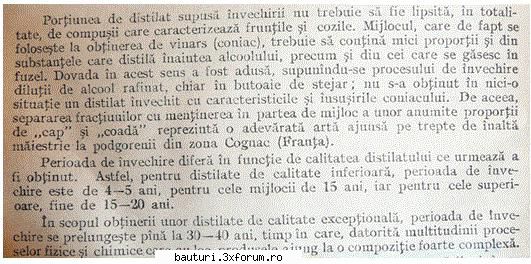
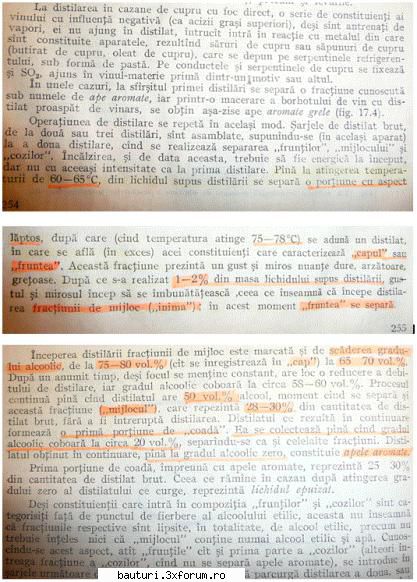
dar aici se vorbeste direct de CAP ... si asa cum am mai zis ... prima e FRUNTEA=PICUSH , apoi vine CAPUL ... apoi vine INIMA -care ne intereseaza ... si la sfirsit e COADA
... dupa o schema ``grosiera`` de tipul 5 +15+55-60+15 ... in procente
ARTA E ... CIT DIN CAP SI CIT DIN COZT TII PT AROMA ... ... aici nu sunt retete standard ... pt ca depinde de plamada , depinde de cazan-tip, costructie ... si mai depinde de PAPILA distilatorului ...
si asta e parerea lor !
_______________________________________ "O să intru în păcat,/Sfinte Doamne, ţine-mă! Pentru vin nu am ficat,/Pentru apă... inimă! "PĂSTOREL
Pana la urma tot papagalul e inginer pe separarea fractiior.
PAPAGALUL e f. important ... (ce iese - taria depinde de ... costructia instalatiei ... ... si eu nu am vazut inca faimosul prag dintre fractii ... pt ca nu e chiar un prag ... e o trecere destul de RELATIV-RAPIDA ... dar PUTEM ZICE CA variatia de concentratie e f. lenta incadrul INIMII )
dar pt mine pe locul 1 e PAPILA ... ... si pe 2 e CALCULUL ( ca sa nu gust acetona ... etc.) SAU invers ca incep sa gust dupa ... ce a iesit fruntea din calcul ...
_______________________________________ "O să intru în păcat,/Sfinte Doamne, ţine-mă! Pentru vin nu am ficat,/Pentru apă... inimă! "PĂSTOREL
Mai important decât papagalul la separări este termometrul aşezat corect. Gustul este cel mai înşelător dintre toate. Mai ales că nu prea simţi corect decât după câteva zile.
După mine ordinea importanţei ar fi:
1. temperatura vaporilor înainte să intre în răcitor 2. procentul alcoolic în timp real 3. volumele calculate pentru fiecare fracţie ştiint cantitatea de alcool din plămadă. 4. gust
Cred că fiecare ar trebui sa aibă nişte borcane numerotate la îndemână în care să adune distilatul atunci când e cu semnul întrebării (de obicei între mijloc şi coada). După câteva zile se gustă şi se stabileşte ce e bun de băut şi ce e pentru redistilare. Fruntea, o cantitate fixă, se aruncă sau se foloseşte în scop nealimentar. Înseamnă 5% din alcoolul din plămadă la instalaţiile cu reflux, sau 1% din cantitatea totală de plămadă la instalaţiile simple. Marja aia diferă în funcţie de conţinutul în pectine al fructului. Oricum, metanolul nu poate fi separat complet, el se regăseşte sub formă de urme şi în fracţiunea de mijloc, ba chiar şi în fracţiunea de coadă.
Fracţiunea de CAP la care se referă Caberlot (cei 15% care vin după frunte) nu se separă la ţuică! ci doar la neutre (alcoolul pentru vişinată de exemplu) pentru că poată diverse arome, lafel ca şi coada.
Ăia 1-2 litri e numai fruntea, Caberlot. În exemplul ce l-ai dat sunt 100 de litri de distilat brut la 25% alcool, adică ce iese cam din 300-500 kg plămadă de prune.
_______________________________________ ÎNVINUIRE = Procesul de transformare a mustului în vin ÎMPRĂŞTIERE = Rezultatul procesului prin care beţivii se fac praştie
Stie ardeleanul ce face cand colecteaza distilatul la trecerea intre fractii in paharele pe care le aliniaza in ordinea colectarii si apoi le analizeaza gustand si mirosind.
Fruntea, o cantitate fixă, se aruncă sau se foloseşte în scop nealimentar. Înseamnă 5% din alcoolul din plămadă la instalaţiile cu reflux, sau 1% din cantitatea totală de plămadă la instalaţiile simple.
Fracţiunea de CAP la care se referă Caberlot (cei 15% care vin după frunte) nu se separă la ţuică! ci doar la neutre (alcoolul pentru vişinată de exemplu) pentru că poată diverse arome, lafel ca şi coada.
Ăia 1-2 litri e numai fruntea, Caberlot. În exemplul ce l-ai dat sunt 100 de litri de distilat brut la 25% alcool, adică ce iese cam din 300-500 kg plămadă de prune.
de ce e 5% la reflux ? nu cumva e invers ... intotdeauna m-am gindit ca coloana cu reflux e mai performanta ...
... ma gindeam sa mai modific cite ceva ... si sa bag-ADAUG si ceva reflux (UN RACITOR IN COLOANA ) pe la coloana mea ... ... dar daca nu imbunatateshte separarea fractiilor ... ATUNCI O SA FAC 3 DISTILARI CA IRLANDEZII DE LA JAMESON ...
_______________________________________ "O să intru în păcat,/Sfinte Doamne, ţine-mă! Pentru vin nu am ficat,/Pentru apă... inimă! "PĂSTOREL
5% din alcoolul din plămadă am spus. Adică dacă în 100kg plămadă ai 8 litri alcool pur, fruntea înseamnă 400ml. Evident mai puţin decât separi la o instalaţie simplă (adică cam 1 litru).
_______________________________________ ÎNVINUIRE = Procesul de transformare a mustului în vin ÎMPRĂŞTIERE = Rezultatul procesului prin care beţivii se fac praştie
Eu separ intotdeauna 50ml la 20kg de plamada... adica la cazanul de 100 separ un fartai, cam la toate fructele. S-a intamplat cand am crezut de cuviinta sa separ mai mult, in general cand fructele n-au fost de o calitate stralucita, insa niciodata n-a fost necesar sa separ peste 500 ml... Un litru e mult prea mult dupa parerea mea, pentru ca si parte tolerata din frunte poarta destula "vina" pentru gustul final al distilatului... oricum o separare completa a fruntii nu va putea fi realizata prin mijloace rudimentare...
Hai noroc!
_______________________________________ Decat mult, prost si ieftin, mai bine putin si bun, la acelasi pret !
Sunt complet deacord, otrava se duce cu primele picături. Totuşi în mai multe cărţi am citit chestia cu 0,5-1,5% din plămadă. În fructe se produce alcool metilic din pectine. 50ml din 20kg plămadă nu cumva e cantitatea de frunte la plămezile din cereale sau zahăr? Cereale şi zahărul nu sunt libere de metilic? Întreb, că doar tu eşti profesorul
_______________________________________ ÎNVINUIRE = Procesul de transformare a mustului în vin ÎMPRĂŞTIERE = Rezultatul procesului prin care beţivii se fac praştie
... am gasit o carte , in format PDF ... si in engleza ... si cred ca intereseaza pe mai multi cum se fac separarile ...
asta e cartea Craft of Whiskey Distilling
... si asta e parte cu separarile (e vorba de grade F)
MAKING THE CUTS Probably the most elusive part of the distilling process for making whiskey, is making the cuts from heads to hearts and then to tails. Making a cut from one phase to the next is the point where the distiller switches the output so that itís collected in a different receiver than the previous phase. At the end of the spirit run, the heads will be in one container, the hearts in another, and the tails in a third one. The question is, when to switch from one phase to the next? Experienced distillers do this by taste. Even though there are measurable parameters like still-head temperature and percent alcohol of the evolving spirit that can be used to judge when to make the cuts, taste and smell still remain the most reliable method of determining them. The empirical parameters for judging the cuts are: the percent alcohol of the spirit that’s flowing out of the still (i.e. the evolving spirit); and, the still-head temperature. However, these vary from one still to the next, and vary based on the properties of the low-wine (e.g., percent alcohol, and quantity). It is possible to develop a consistent process using the same still and the same quantity and a formulation of low-wine, such that the parameters remain the same for each run. For example, if a spirit run is being done in an artisan reflux still with low-wine that is 35% abv, the begin-cut (i.e. the cut from heads to hearts) is usually done when the evolving distillate is at about 80% and when the still-head temperature is about 180 degrees. And, the end-cut (i.e., the cut from hearts to tails) is often done at about 65% and when the still-head temperature is about 200 degrees. However, a spirit distilled from a straight malt wash, can often be end-cut as low as 60%. It’s because of these nuances that smell and taste become the only truly reliable indicators of when to make the cuts. When making the begin-cut, the taste characteristics that the distiller is looking for are as follows. When a spirit run comes to boil and the first d istillate starts flowing from the still, this is the beginning of the heads phase. The distiller can collect a small sample of the distillate on a spoon or in a wine glass and smell it. At this stage, the distillate will have the sickening smell of solvents like nail polish remover or paintbrush cleaner. However, before long this solvent smell will diminish, and even when a sample is tasted these compounds will be very faint. As the solvent character disappears completely, the distillate will start to take on a hint of whiskey flavor. This flavor will increase until it becomes very pronounced and highly concentrated. It’s when this flavor is clearly evident (i.e., more than just a hint) but is still increasing in intensity that the distiller cuts to the hearts phase. AMERICAN DISTILLING INSTITUTE | !" To make the end-cut the distiller needs to monitor the flavor of the hearts through the following changes in taste. At the beginning of the hearts phase, the intensity of the whiskey flavor will still be increasing, and will continue to do so until it becomes very strong. However, as the hearts continue, the intense whiskey flavor will fade into a smooth, sweet, pleasant flavor that will persist for most of the hearts. The flavor will change slightly as the hearts progress but it will remain sweet and pleasant. Towards the end of the hearts, the flavor will start losing its sweetness and a trace of harsh bitterness will being to appear in the flavour. This harsh, bitter flavor is the onset of the tails. While a small amount of this bitterness is considered to contribute to the “bite” character of the whiskey, the distiller should cut to the tails receiver before mush of it is allowed to enter the hearts. The tails can be collected until the evolving distillate is down to about 10% and the stillhead temperature is about 210 degrees. The reason for doing this is to render all the residual alcohol that’s left in the still at the end of the hearts phase. This alcohol can then be recovered in a future spirit run. The tails phase starts out bitter, and the bitterness becomes more intense as the tails continue, but as the tails progress, the bitterness subsides and gives way to a sweet-tasting water. This sweet water is called “backins.”
_______________________________________ "O să intru în păcat,/Sfinte Doamne, ţine-mă! Pentru vin nu am ficat,/Pentru apă... inimă! "PĂSTOREL
... cred ca tabelul asta ... va fi foarte interesant pt unii cu studii si care ne prepara bucurii pt. ficat dar si pentru aia care studiaza si produc licori pentru inima si sufletul lor
... daca te uiti si ... cine sunt producatorii => ce marci rezulta din ce distila ei incepi sa ii crezi ca lucreaza asa
oricum ... se pot trage ceva concluzii ... de costructie alambic ... de distilare ... de separare fractii etc.
_______________________________________ "O să intru în păcat,/Sfinte Doamne, ţine-mă! Pentru vin nu am ficat,/Pentru apă... inimă! "PĂSTOREL
#20
pazucu Moderator Din: Humoreni , Suceava
Postari: 839
daca tot veni vorba : eu la tuica care a degustat-o sinenomine si a zis ca i-a placut am scos cam 400 ml frunte din 65 l rachiu brut la 26% si apoi am amestecat cu mijlocul coada care avea cam 30% . precizez ca cel putin la tuica de sfecla la lamurit scaderea de la 60% la 30 % este relativ scurta . de exemplu azi ,cand a inceput sa curga sub 60 % au curs vreo 2l pana la 50% si apoi 2l pana la 40% si 2 l pana la 30 % . dupa asta am mai colectat 6 l media 20% pentru al pune intr-un cazan cu taitei data viitoare . ce ziceti ,e bine ?
_______________________________________ "nimic nu se pierde ,totul se transforma"